 CarromTalkPlay free
CarromTalk › Learn carrom › Carrom glossary
Carrom glossary: terms, board markings and what players call things
Carrom has a small vocabulary and every game of it is argued over. These are the words that matter, with the meanings from the International Carrom Federation Laws where they define them.
The equipment
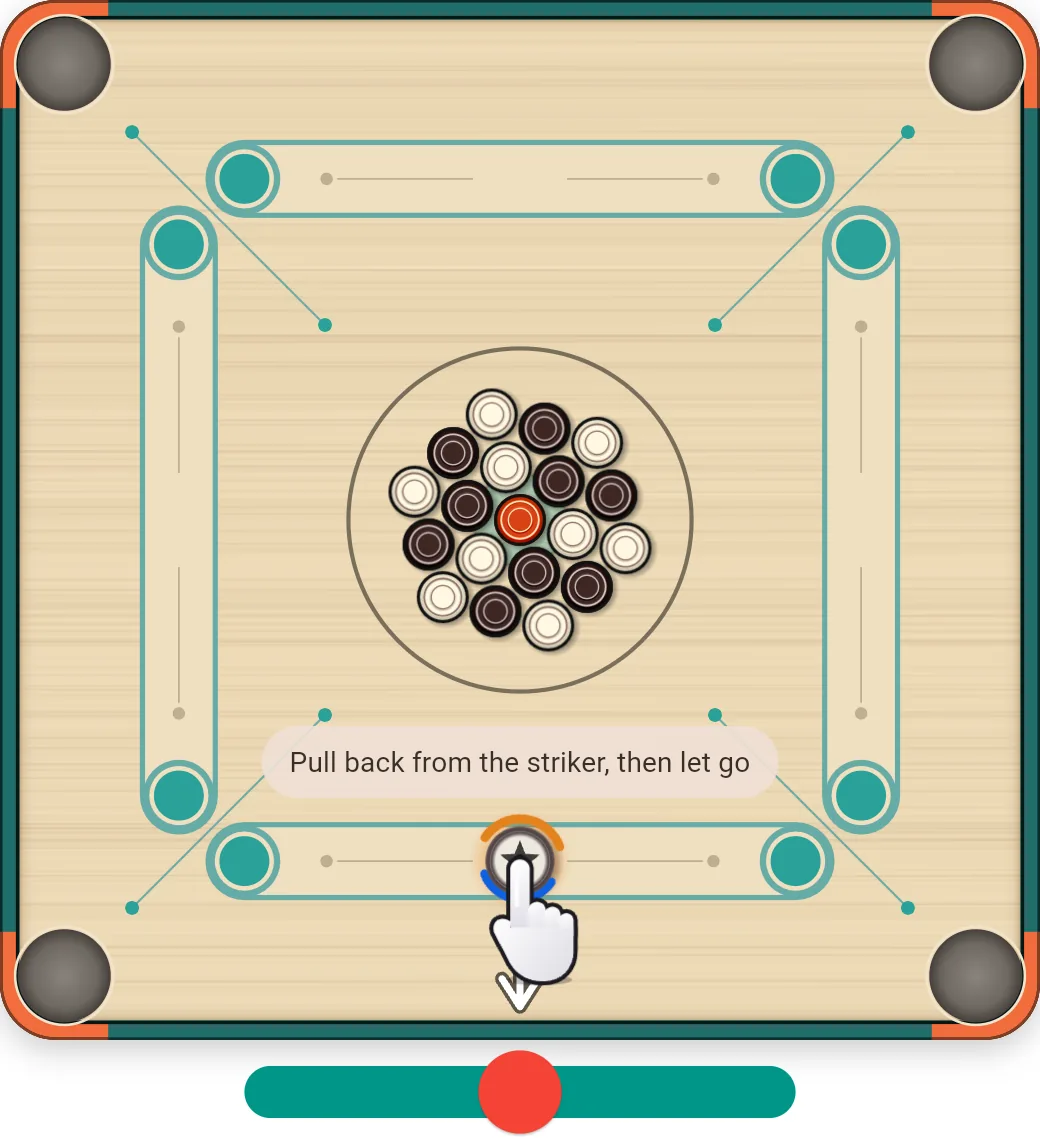
Carrom man (carrommen, coin, goti or guti): one of the 19 pieces: nine white, nine black and the red queen. The Laws call them carrom men; "coins" is common in everyday English, and गोटी (goti) in Hindi and গুটি (guti) in Bengali mean the same thing. If you were searching "carrom board goti in English", that is the answer. Each is 30.2 to 31.8 mm across.
Striker: the heavier disc you flick. At most 41.3 mm across and 15 g, smooth and round, with no visible fixed metal.
Queen: the red piece, placed at the exact centre. In Hindi, रानी, and in Bengali, রানি. It is worth 3 points when you cover it.
Frame: the wooden border. It is what you rebound off.
Pocket: one of the four corner holes, 44.5 mm across.
Powder: the fine dust sprinkled on the surface. See carrom powder and board care.
Markings on the board
Base line: the pair of lines on each side, 47 cm long, where the striker rests. The nearer one is 10.15 cm from the frame.
Base circle: the 3.18 cm circle at each end of a base line, with a 2.54 cm red centre. The striker may sit on one but must then cover it completely.
Arrow: the diagonal line in each corner, at 45 degrees, running through the gap between two base circles toward the pocket. The striker may not touch it at the start of a shot, and the elbow may not cross it.
Centre circle: the red 3.18 cm circle in the middle, where the queen goes at the start and where pieces are returned.
Turns and strokes
Break: the first stroke of a board. The player who breaks takes white. A player gets three tries at the break before the turn passes.
Board: one round, from the break to the finish. A game is won by the first player to 25 points, or by whoever leads after the eighth board. A match is decided by the best of three games.
Turn: the right to strike. You keep it while you keep pocketing your own pieces.
Stroke: hitting a carrom man with the striker, directly or indirectly.
Flick vs push: the striker must be flicked with the fingertip. A push is a jerk or sudden movement of the elbow, and it is illegal.
Thumbing: taking a stroke with the thumb. Defined in the Laws and allowed by the ICF according to Wikipedia, but often banned by clubs.
Slip: the striker slides off a base line or base circle. It counts as a stroke only if it has left the line or circle.
Queen, cover, due and fouls
Cover (covering): pocketing one of your own pieces in the same stroke, or the very next one, after you pocket the queen. Fail and the queen goes back to the centre.
Due: pocketing the striker, with or without a piece. You lose the turn, and your opponent puts one of your pocketed pieces back in the centre circle. If you have not pocketed any yet, you owe one.
Foul: a violation during or after the first stroke of your turn. It costs you the turn and one carrom man brought out for placing.
Technical foul: a violation before your first stroke, or by a player whose turn it is not. Your opponent brings out one carrom man for placing, and the turn continues.
Penalty: any punishment for breaking the Laws.
The scoring side is in scoring and fouls.
Tournament words
Umpire and Chief Referee: the officials who supervise and control a match.
Singles, doubles, team: the three event types at ICF tournaments. Doubles and teams are played with partners seated opposite each other. CarromTalk's tables seat two, so online you play singles.
Swiss league: an open event format used alongside the main events at ICF tournaments, for example at the 2022 World Championship. The Laws do not define it. Everyone plays a set number of rounds against opponents of similar standing, rather than being knocked out.
DRS: the electronic umpiring system the host federation says it will use at the 2026 World Championship in Italy. See World Cup and World Championship.
Names of the game itself
Carrom, carom, karom, karam, karrom: they are the same game. Where the names come from is in names and variants.
Frequently asked questions
What is "due" in carrom?
Pocketing the striker, whether or not a piece goes in with it. You lose the turn, and your opponent puts one of your pocketed pieces back in the centre circle (you owe one if you have none yet).
What does covering the queen mean?
After you pocket the queen you must pocket one of your own pieces in the same stroke or the next one. If you do not, the queen goes back to the centre.
What is a push in carrom?
A sudden jerk of the elbow instead of a flick of the fingertip. The striker must be flicked, and a push is a foul.
What is goti in carrom?
Goti (গুটি in Bengali, गोटी in Hindi) means the pieces, called carrom men or coins in English. There are 19: nine white, nine black and the red queen.
Sources
- Laws of Carrom, UK Carrom Federation (definitions and laws)
- Carrom Rules, UK Carrom Federation
- Carrom, Wikipedia
- Carrom World Championship 2026, Federazione Italiana Carrom (DRS)