 CarromTalkPlay free
CarromTalk › Learn carrom › Carrom shots and striker grips
Carrom shots explained: grips, cuts, rebounds and the thumb shot
Videos titled "10 carrom shots you must practise" get millions of views, and most of them show a shot without saying why it works. This page explains the grips and the geometry, and says what the rules allow.
How to hold the striker: five common grips
The Laws do not say which finger to use. They say the striker must be struck and not pushed, and they define a push as a sudden jerk of the elbow instead of a flick of the fingertip. So the choice is yours. Carrom equipment seller Precise Sports lists five styles that cover most players:
- Index finger: the tip rests behind the striker, lightly on the board, and the flick comes from the first joint.
- Middle finger: the same, with the longer finger.
- Thumb and middle finger: the middle finger strikes and the thumb rests on the board for balance.
- Vertical long finger: the finger is held upright above the striker, lifted slightly, and flicked down and forward.
- Scissors: index and middle fingers either side of the striker, flicked together.
The UK Carrom Federation adds a limit: for forward shots use the index finger, middle finger or scissors, and for back-shots the thumb or scissors only. In every case steady the hand with the heel of the palm, the thumb or the other fingers, keep the striking finger close to the striker, and flick. Nothing but the playing hand may touch the board, and the elbow may not go inside the frame. The hand may cross the arrow lines, the elbow may not.
Where the striker starts
It must touch both baselines, and if it sits on an end circle it has to cover the circle completely. It may not touch the arrow line. Each baseline is 47 cm long, so you have most of the width of the board to choose from, and choosing well is half of every shot.
Straight shots and cut shots
A straight shot is a piece with a clear path between the striker and a pocket, in a line. A cut shot is any shot where the striker hits the piece at an angle to send it somewhere the striker is not pointing. The UK Carrom Federation's practice page gives a neat way to think about it: look at the angle at the piece between the line back to your striker and the line on to the pocket. At 180 degrees it is a straight shot. At 90 degrees or less, you cannot pocket it at all. Everything between is a cut, easier near 180 and harder toward 90, and needing more force when the piece is far from the pocket. They put it as "Cuts are more difficult than straight shots because you have brought in two extra variables": the angle, and the force.
A worked example, with rough numbers. A black piece lies just left of the centre circle and you want the top-left pocket. Put the striker at the right end of your baseline and the striker, piece and pocket sit almost in one line, about 175 degrees: close to a straight shot, forgiving of a small error. Move the striker to the left end and the striker has to turn the piece through roughly 75 degrees, which leaves about 105 degrees at the piece, only just over the 90 where it becomes impossible. The same piece, the same pocket, and one end of the baseline is easy while the other is a lottery. Choosing the end that gives the straightest line usually matters more than hitting harder.
Rebound shots
When another piece blocks the line, bounce the striker off the frame. A rule of thumb is that the striker leaves the frame at about the angle it arrived, though powder and spin move it a little. The trick I use to find the aim: imagine the frame is a mirror, and aim at the reflection of the piece. Pick the point on the frame where the line from your striker to the reflection crosses it. Then adjust for force. A rebound loses speed, so you need a firmer flick than a direct shot over the same distance.
Is the thumb shot legal?
The Laws define "thumbing" as taking a stroke with the thumb, and Wikipedia says thumbing is allowed under ICF rules. The Laws also say the stroke is made with a finger, with or without other fingers supporting it. Players read that differently, and club or house rules often ban the thumb outright, so agree it before the first flick. The UK Carrom Federation allows the thumb for back-shots.
Combinations and "doubles"
Pocketing two pieces with one stroke, or hitting one piece into another, is allowed, and the UK rules say luck shots and combinations count. What a "double" is depends on who you ask: some players use it for two pieces pocketed at once, others for a rebound off the frame before the target. When someone says it, ask.
Drills that fix your aim
- Pocket the striker five times in a row from each end of your baseline to the matching top pocket, then the cross-board shots. For a right-hander, the right end to the top-left pocket is the hard one because of the elbow rule.
- Line up nine pieces near your baseline and try to pocket all nine, counting attempts. Then move the row toward the centre.
- The calibration test: flick so the striker rebounds off the far frame and stops on your opponent's baseline.
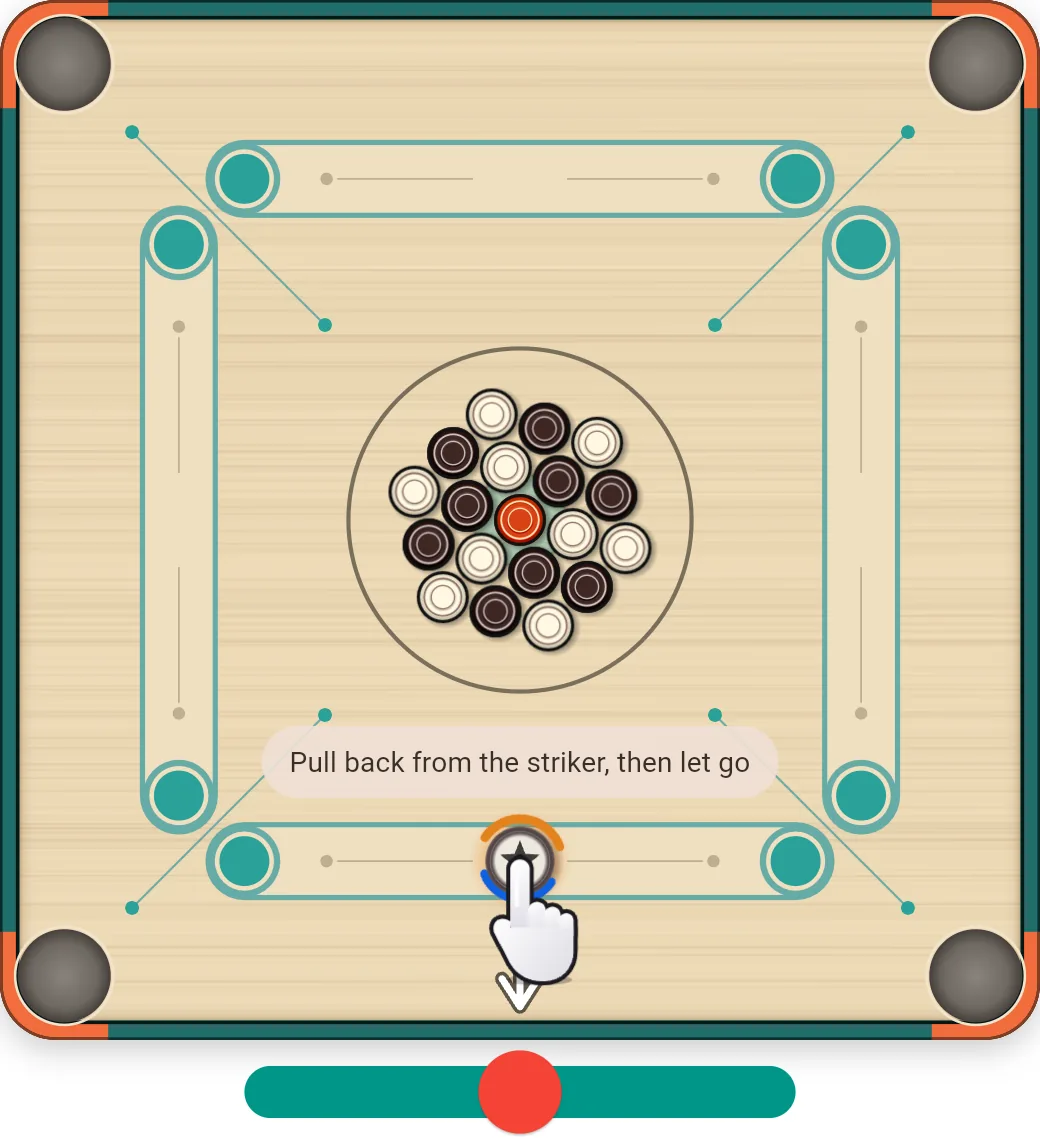
On CarromTalk you pull back and release rather than flick with a finger, so the grips above do not carry over, but the angles do. The table seats two, and you can talk to each other while you play. More on lines and defence is in the strategy guide, and the glossary explains the terms used here.
Frequently asked questions
Which finger is best for carrom?
There is no best. Index and middle finger are the most common, and scissors uses both. Choose the grip that lets you flick cleanly rather than push.
Is thumbing allowed in carrom?
The ICF Laws define thumbing, and Wikipedia says it is allowed, but the Laws also say a stroke is made with a finger. Many clubs ban it, so agree it before play.
What is a cut shot in carrom?
A shot where the striker hits the piece at an angle to send it toward a pocket. The closer the striker, piece and pocket are to a straight line, the easier it is.
How do I aim a rebound shot?
Pretend the frame is a mirror: aim at the reflection of the piece, and the striker bounces into it. Use a firmer flick because the rebound loses speed.
Sources
- Improving Your Game, UK Carrom Federation (straight shots, cuts, drills)
- Carrom Rules, UK Carrom Federation (grips and body position)
- Different Striking Styles in Carrom, Precise Sports
- Laws of Carrom, UK Carrom Federation (push, thumbing, striker placement)
- Carrom, Wikipedia